INTERVISTA
DI MAGGIE WILLIAMS –
AUTUNNO 2004 –Double Bassist
|
|
|
|
|
|
|
"Singing
from the soul " |
|
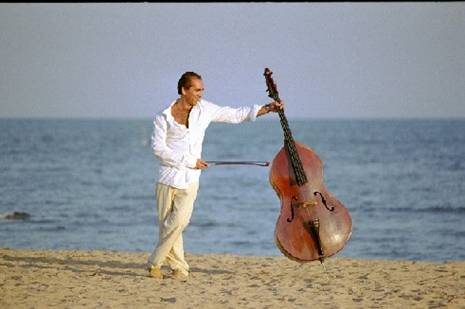
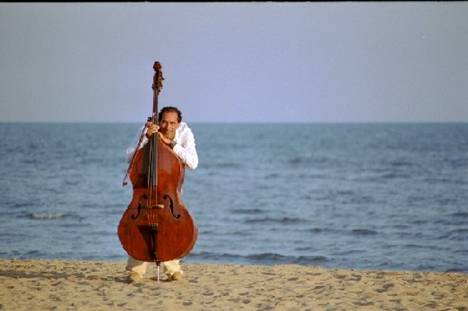
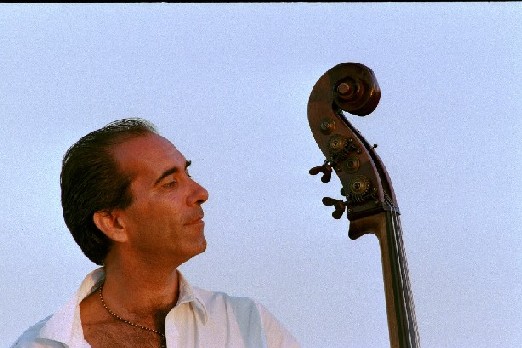
Stefano
Sciascia's mission is to encourage bassists to look to their soul for
inspiration. He opens his own to Maggie Williams
As anyone who has ever played a solo
work will know, there's more to successful interpretation than merely getting
the notes and rhythms correct. Emotional involvement and the ability to bring your
own character to a performance are equally important, and these are facets that
Italian soloist Stefano Sciascia has put at the
centre of his own art. Born in
'We did a European tour, performed at the
Edinburgh Festival and saw some beautiful places. I began to understand about
orchestral playing, and how it would be to do this as a profession,' he
recalls. After completing his studies, Sciascia
continued his orchestral career, joining the Turin Radio Symphony Orchestra. He
supplemented his section work with Baroque performances on modern instruments
through I Solisti Veneti di Claudio Scimone, and played
Classical period works with l'Orchestra da Camera di Padova
e del Veneto.
While inspired by his orchestral and chamber
experiences, Sciascia discovered that these roles
only partially fulfilled his musical desires. 'I got to play with many soloists
through my orchestral work, and that made me realise there was something inside
me that I wanted to express. It's very beautiful to hear an orchestra or a bass
section all together, but it's like a choir - you can't hear your own voice.'
The young bassist started to work on a more individual means of expression. He
studied Bottesini's solo works during breaks in his
orchestral schedule, and after a mere two to three months, hired a studio to
make 'a simple record' of some of these pieces with the pianist David Giovanni Leonardi - who remains Sciascia's
regular accompanist. 'We made a basic recording, and then I decided I wanted
someone to publish it. It wasn't a very good tape, though,' he concedes.
'I went to [record companies in]
He created music around vocal works, lots of
fantasies based on Italian arias.' The bassist hasn't lost his passion for Bottesini, and ten years after his first solo CD, he
intends to record some further works by the Italian composer. 'When I play
live, I always include some Bottesini in my
recitals,' Sciascia explains. 'Friends have often
suggested that I make a CD of some pieces, but every time I've tried to settle
down to record them in the past, I've had a new idea and it's got put to one
side. Hopefully, now it'll happen.' Sciascia will be
visiting the studio in July to record the works, with the CD due for release
some time in 2005. Recording the Bottesini
repertoire will mark Sciascia's second session in the
studio this year.
At the beginning of 2004 he created a CD of
his own compositions, taking a radical departure from his previous projects.
'The CD's not really classical music, not ambient, not ethnic - in fact, I'm
not sure how to classify it!' he explains. 'Once it was finished, I asked lots
of people what they thought, and many said it sounded like a soundtrack, with
images of wind, water and suchlike. So, it's a soundtrack, to a year of my
life.' Titled Mantra 22:22, the work uses the bass on its own
but also with overdubs, multi-tracking and other studio techniques.
'It's all improvised, and completely different from everything else that I've
done. I had the ideas when I was teaching, then went to Infinity Studios in
Encouraging all bassists to play from their soul is Sciascia's mission in his teaching, both with his regular
students at the Conservatorio di
musica Giuseppe Tartini in
Regardless of whether he is giving a live performance
or recording for CD, the importance of bringing his soul into the music remains
the same for Sciascia. 'Many people say that it's
easy to record, as you can edit afterwards,' he muses. 'But I think everyone
should try recording before they say that! Yes, it's easy to cut things, but
you could end up being in the studio for a whole month, and that's expensive.
In reality, you have two to three days, and you have to be able to leave
something of yourself in that CD, it will be there forever. When you record,
you have to be in the right mood all the time, it's
hard work.' Sciascia's process of recording provides
him with some time for reflection before editing begins. 'I like to play a
piece three times without stopping, then I go home afterwards and choose the
best parts from the recordings, where I hear the emotion is there - that's the
most important thing.' Preparing for a live recital requires a different
approach. 'As musicians, you make yourself quiet before playing,
you can do meditation, Feldenkrais exercises,
anything to become quiet. Then, you go on and you're not quiet! Before a
performance, there are a lot of distractions, but the moment you go out onto
the stage, you're quiet, the audience is quiet, everyone is silent, and it's
like magic. There's something in the air.'
With a schedule of over 15 live recitals this year
in
Sciascia sums up his approach to music, saying 'we need more communication
between people - it's a mission to make people laugh, cry and feel things. The
importance of the music is to make you feel free, and I play to lighten the
hearts of other people. I hope I can help everyone else to do these things as
well.' Whether listening to his CDs or in a live performance, Sciascia leaves a part of himself in the music, and with
his audience.
Issued
: Autumn 2004
Version Published Sep.2004