Stefano Sciascia
Production
|
|
|
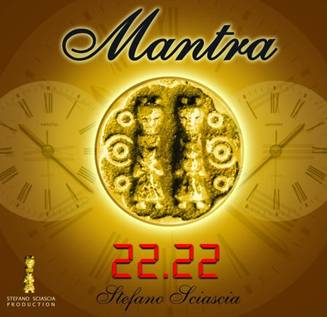
Click on the immage above and
download Click
on the immage above and download
Mp3 extract of
this CD (Part 1) mp3 extract of
this CD (Part 4)
to listen http://www.apple.com/quicktime/download/
BASS
WORLD ISB MAGAZINE –Review- Spring 2005-
This is a
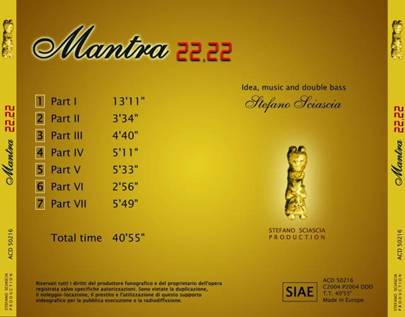
forty-one minute meditative study for multi-tracked double basses Sciascia
states that all of the sounds are naturally recorded except a low drone on the
first track. Although Sciascia does not define his intentions, the CD appears
to be one composition that is broken up into seven parts with an almost
constant ‘B’ drone and an overall reflective, almost hypnotic mood providing
structure and continuity.
The pace
of this CD is very slow and the title of Mantra
is entirely appropriate. As previously stated, there is a drone present almost
the entire time upon which Sciascia introduces and sustains different
treatments (or ‘variations’). The first track is a long (thirteen minute)
multi-tracked duet often employing high harmonics and ponticello sounds. Part two stands out because it is the one
movement of the composition in which the drone is not present, although it
almost continues to be heard subconsciously after being played for so long in
the previous track.
Perhaps
the most striking movement is in the concluding track on which the drone sounds
for nearly six minutes with nothing but the various partials resulting from the
‘B’ fundamental being accentuated (reminiscent of some of Stefano Scodanibbio’s
work). In addition to different melodic treatments, Sciascia also includes
accentuated breathing noises as part of the music in the third track.
The
following excerpt from the poem by Laura Menegozzo that is printed in the CD
jacket gives an indication of Sciascia’s inspiration for this atmospheric and
strangely interesting conceptual recording: “It is melody, / And it vibrates
with deepness… / Of places far, / It tells of love / And it rests on a bed of
water… / The spell! / All of a sudden it silently surrenders / And God himself
stops to listen.” - Review by Sandor Ostlund
To order new Stefano Sciascia CD please write to:
or
From a mail by Dott. Vito Liuzzi ,trad.M° Beppe
Andreoni .
“Mantra
22:22” doesn’t mark a definitive passage of Stefano Sciascia to a new
conception of perceiving the sonorous phenomenon of double bass, in more
abstract and descriptive way. Simply, it’s a real need of the compositor, which
results to be more “visual”, and meantime, shows a philosophy, a world, in a
wise and excellent way. A different approach to common hearing, absolutely
innovative and strong, in its primordial essence: it’s the Indian way of
thinking.
From
here, the ability to reproduce, through the cavernous and sometimes threatening
sound of a Double bass, the depth of Indian philosophy, its natural tendency to
a fixity of a time that never roll. Sometime pedantic, but that bring the man
back to his real nature, to his old roots, to the power of his thought. It’s a
tool to think, or a way to think at the tool ? It’s no easy to give a final
answer, neither an answer worthy of further considerations. Maybe the answer is
included only in the heart of this artist, that create (in this case the verb
“to create” isn’t used in improper way) a real metaphor of a earliest time,
fixed, immutable, but that everyone would like to live, in a life that often
rolls in the opposite direction of time.
The
feeling is that the Stefano Sciascia’s double bass has been transformed in a
real “mantra instrument”. This whistling, this deep search of a absolutely
atypical timbre for this instrument (now no more relegated to second leading
role), this large vibrato, that become a wave that sweeps away everything, this
careful and sage use of a technological sagacity that suit so well to beloved
mastodon, render this work unquestionably innovative, that sometimes remind to
a softly and suffused atmospheres, that the occidental people could admire, but
that don’t correspond anymore to our phrenetic and deafening rhythms. The
feeling is that you are not to listen to a double bass, but a totally different
“instrument”, atypical, unusual, as ancient as the Indian culture. It’s
possible that even a expert can not fully perceive the double bass timbre which
become coloured, and extremely variegated, thanks to the hands of the
“Maestro”. This conceptual characteristic, out of common places of traditional
interpretation, demonstrates the extraordinary sound of Mantra 22:22. The
successful of conceiving the time, the meditation, the mental liberation of
daily anguish, in a unique and coherent musical speech.
It’s the
music that become thought, or the thought that become music. Personally, I’ve
always appreciate the Stefano Sciascia’s virtuoso technique, Never without a
purpose; His phrasing with a thousand of colours that follow one another, like
an idea of naturalistic paint description; his personal way to interpret the
big of the past. Under an totally different situation from the usual one.
However,
in this situation, his breathlessness panting, the wish to create a magic
atmosphere (together with a proposal of old instruments using the bow in
particular positions, and extremely calibrated glissando), the careful using of
a vibrato that delay to appear, but then opens and closes as he likes, make this
musical thought not more modal, no more linked with the temperament of
mathematic logic of numbers, but clearly non-modal or maybe pluri-modal. Some
years ago, someone could change this sonorous conception like a philosophic
thought linked to new-age world, authentic and genuine.
Considering
this a new-age music is not a big mistake, if you think to the real essence of
this kind of music that, due to more demanding but less prestigious market,
lost its deeper essence: the holistic conception of the world. When the men,
the spirit, the nature and the gods become all in one, a vital flow with no
division. I have to tell him Bravo!! Even thought would seem a little word.
Above all is extremely clever because has succeeded proposing a new “sonorous
subject”, almost like a platonic demiurge that mould it as he likes. I think
that Sciascia succeeded, with a simple and modest double bass, to re-create a
sonorous world completely different, heir to way of thinking of Indians, of the
Tantra and “de relato” of the Mantra. This obstinate pedal, very long, this
soft phrasing, this devastating singing, these small but intense
participations, almost like a canon. This sonorous spin that remind the fixity
of a time that floats among past, present and future with a single reference
point, renders this work extremely original. Placing the artist to a
dimensional and sonorous levels of great value. A double bass, a bassist that
talk like a philosopher, a new western Siddharta. For the first time, a
classical double bass work with a cause-effect continuity can be listened where
the numerical division is only symbolic. After this Sciascia’s “invention, even
the word “classic” seems not to correspond totally to this composition, or
better, is not suited in such a way to render justice to a new instrumental
timbre which has been created with wisdom, shrewdness and visual intelligence,
avoiding that the technological element overhangs the natural instrument
expressiveness. An extremely charming and far-sighted sonorous theatre, but
also brave, and, under a certain visual, even surprising.
“Mantra
22:22”: the fixity of a time that flows in a constant way, but that squeaks
with a western world conception, where it has assumed a uniform accelerated
speed, without respect of nature rhythms. A totally new, brilliant and
innovative dimension, under a pure experimentation profile. Without to forget
the aspect linked to the CD material realization, where recording quality,
stereophonic effects, channels level and reverberation depth, are optimal, with
the constant idea that the final result has to be well calibrated, never
overflowing.